Daniel Rahl Jackson

Home › The 36 Stratagems

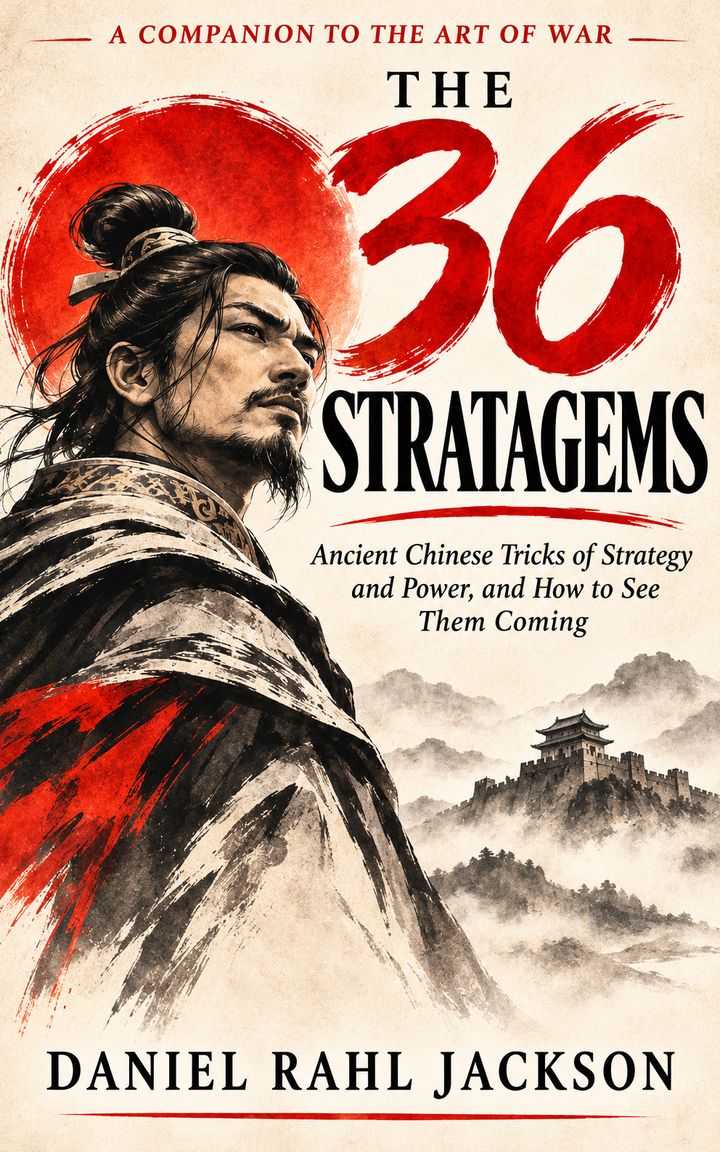
Cover of The 36 Stratagems by Daniel Rahl Jackson
Reference · All thirty-six

The 36 Stratagems

All thirty-six in Chinese, pinyin and English, what each one means, and how to see it coming

三十六計 · Six parts · Thirty-six moves

The Thirty-Six Stratagems (三十六計, Sānshíliù jì) are a short Chinese collection of tricks for war, politics and rivalry. Each is a four- or three-character phrase, often taken from a famous episode in Chinese history or legend. Where Sun Tzu's Art of War explains how to think about conflict, the stratagems name the moves themselves.

Nobody knows who compiled them. The phrase “thirty-six stratagems” already appears in the Book of Southern Qi, a history from the sixth century, in a line still quoted today: of the thirty-six, running away is the best. The short anonymous text read today was printed in the twentieth century from an older manuscript, and arranges the stratagems in six groups of six.

Below are all thirty-six, with the Chinese name, pinyin and the usual English name, a short explanation, and how to see each one coming when it is used on you.

Part 1 · Stratagems 1–6

Stratagems when winning

When you hold the advantage: how to press it without giving yourself away.

  1. 1 瞞天過海Mán tiān guò hǎi

    Deceive the Heavens to Cross the Sea

    Do the real thing in full view, but make it look so ordinary that nobody pays attention. Something repeated openly often enough stops being watched, and that makes it a better hiding place than any secret.

    See it comingBe careful with what you have stopped checking because it always happens the same way.

  2. 2 圍魏救趙Wéi Wèi jiù Zhào

    Besiege Wei to Rescue Zhao

    Don't meet a strong attack head-on. Threaten what the attacker can't afford to lose, and they will turn back on their own. The name comes from the Warring States, when Qi relieved its ally Zhao by marching on Wei's undefended capital.

    See it comingA sudden threat to something you value, just as you are winning somewhere else, may be meant to pull you back.

  3. 3 借刀殺人Jiè dāo shā rén

    Kill with a Borrowed Knife

    Get a third party to do the damage, so the cost and the blame fall on them. The person who planned it stays clean and keeps their strength.

    See it comingWhen two parties are being set against each other, ask who gains from the fight and isn't in it.

  4. 4 以逸待勞Yǐ yì dài láo

    Wait at Ease for the Weary

    Let the other side spend its energy while you save yours. Choose the ground and the time, and meet them when they arrive tired.

    See it comingBeing kept busy, rushed or made to travel to someone else's ground is often the point.

  5. 5 趁火打劫Chèn huǒ dǎ jié

    Loot a Burning House

    Strike while a rival is already in trouble, whether that's a crisis, an internal quarrel or a disaster. It is the harshest of the stratagems, and the one that most often turns into plain opportunism.

    See it comingYour worst week is when others are most likely to move against you. Watch who appears with an offer then.

  6. 6 聲東擊西Shēng dōng jī xī

    Make a Sound in the East, Strike in the West

    Draw attention and defences to one place, then act somewhere else. The noise has to be believable, or it warns instead of distracting.

    See it comingWhen the signal is very loud and very easy to read, look at the opposite side.

Part 2 · Stratagems 7–12

Stratagems for facing the enemy

When the sides are close: deception, timing and quiet gains.

  1. 7 無中生有Wú zhōng shēng yǒu

    Create Something from Nothing

    Show a false picture until the other side learns to ignore it, then turn the false into the real. Bluff, rumour and empty threats all prepare the ground.

    See it comingSomething that has been harmless many times is not proof it will stay harmless.

  2. 8 暗渡陳倉Àn dù Chéncāng

    Repair the Roads in the Open, March to Chencang in Secret

    Give the other side a visible, slow plan to watch, and carry out a different, faster one out of sight. Liu Bang's general Han Xin is said to have repaired the plank roads in plain view while the army took a hidden route to Chencang.

    See it comingA rival's slow, public preparations may be the cover, not the plan.

  3. 9 隔岸觀火Gé àn guān huǒ

    Watch the Fire from Across the River

    When your opponents start fighting among themselves, stay out of it. Stepping in may unite them against you; waiting lets them wear each other down.

    See it comingSomeone who stays calm and distant during your crisis may be waiting for it to finish you, not to help.

  4. 10 笑裏藏刀Xiào lǐ cáng dāo

    Hide a Knife Behind a Smile

    Win trust with friendliness, flattery or gifts, and strike once the guard is down. The warmth is real enough to work, which is what makes it dangerous.

    See it comingWarmth that arrives suddenly, right before something is needed from you, deserves a second look.

  5. 11 李代桃僵Lǐ dài táo jiāng

    Let the Plum Tree Die for the Peach

    Sacrifice something smaller to save what matters more. Give up a position, a project or a pawn so that the main body survives.

    See it comingIf you are offered as the easy loss in someone else's plan, find out what you are protecting and whether it's worth it to you.

  6. 12 順手牽羊Shùn shǒu qiān yáng

    Lead Away a Sheep in Passing

    Take the small advantages that come within reach while pursuing the larger aim. Many small gains, taken quietly, add up.

    See it comingSmall, unchecked losses that each look too minor to argue about are worth tallying.

Part 3 · Stratagems 13–18

Stratagems for attack

When you move against someone: draw them out, then strike where it counts.

  1. 13 打草驚蛇Dǎ cǎo jīng shé

    Beat the Grass to Startle the Snake

    Make a small, safe move to see how the other side reacts, and learn where their strength is hidden. Used carelessly, it warns them instead.

    See it comingA small, odd test, such as a question, a minor claim or a strange request, may be someone measuring your response.

  2. 14 借屍還魂Jiè shī huán hún

    Borrow a Corpse to Return the Soul

    Revive an old name, title, tradition or institution and use its authority for a new purpose. What seems dead can still lend legitimacy.

    See it comingWhen a forgotten cause or a famous name suddenly returns, find out who has picked it up, and why.

  3. 15 調虎離山Diào hǔ lí shān

    Lure the Tiger Down from the Mountain

    Don't attack an opponent where they are strongest. Tempt or provoke them onto ground where their advantage disappears.

    See it comingInvitations to leave your home ground, whether your market, your field or your city, may be meant to weaken you.

  4. 16 欲擒故縱Yù qín gù zòng

    To Catch Something, First Let It Go

    Cornered people fight hardest. Leave an apparent way out, ease the pressure, and let resistance wear itself out before you close in.

    See it comingA sudden easing of pressure isn't always generosity. Notice where the open path leads.

  5. 17 拋磚引玉Pāo zhuān yǐn yù

    Toss Out a Brick to Attract Jade

    Offer something cheap to draw out something valuable. A small bait, a modest first offer or an imperfect idea can draw a far bigger response.

    See it comingWhen something is surprisingly cheap or free, ask what you will be asked for next.

  6. 18 擒賊擒王Qín zéi qín wáng

    To Catch Bandits, Catch Their Leader

    Go for the centre: the leader, the key decision or the single point that holds the rest together. Remove it, and the rest loosens.

    See it comingKnow what your own key point is, and protect it more carefully than the rest.

Part 4 · Stratagems 19–24

Stratagems for confusion

When the situation is unclear: use the disorder, or slip away through it.

  1. 19 釜底抽薪Fǔ dǐ chōu xīn

    Remove the Firewood from Under the Pot

    Don't fight the boiling water; take away the fire. Cut off what feeds the other side's strength, such as supplies, money, morale or support, and the strength fades on its own.

    See it comingIf your energy, funding or support is draining quietly while the main dispute stays elsewhere, look underneath.

  2. 20 混水摸魚Hún shuǐ mō yú

    Fish in Troubled Waters

    In a muddle, the calm person gains. Use disorder, or stir it up, to take what would be well guarded in quieter times.

    See it comingWhen everything gets muddled at once, ask who benefits from nobody being able to see clearly.

  3. 21 金蟬脫殼Jīn chán tuō qiào

    The Golden Cicada Sheds Its Shell

    Leave the outward form in place while the substance slips away, like a cicada leaving its empty skin on the branch. A withdrawal disguised as staying put.

    See it comingMake sure what you're watching is still occupied, and not just an outline left behind.

  4. 22 關門捉賊Guān mén zhuō zéi

    Shut the Door to Catch the Thief

    Let a small, weak opponent in, then close every exit and deal with them completely. Chasing them only spreads the trouble.

    See it comingAn entrance that is unusually easy, and an exit that suddenly isn't, form a pattern.

  5. 23 遠交近攻Yuǎn jiāo jìn gōng

    Befriend the Distant, Attack the Near

    Make friends far away and take ground close by. Distant allies can't easily turn on you, and gains next door can be held. It is the policy associated with the state of Qin on its way to unifying China.

    See it comingA distant friend who is very keen on your conflict with your neighbour may have their own reasons.

  6. 24 假道伐虢Jiǎ dào fá Guó

    Borrow a Road to Conquer Guo

    Ask for passage, help or access for one purpose, and use it for another. In the classic story, the state of Jin passed through Yu to attack Guo, then took Yu on the way back.

    See it comingGranting someone access is a decision about everything that access reaches, not only the stated purpose.

Part 5 · Stratagems 25–30

Stratagems among allies and rivals

When friend and rival are hard to tell apart: control who leads.

  1. 25 偷梁換柱Tōu liáng huàn zhù

    Steal the Beams and Change the Pillars

    Replace the core of something while keeping its outside the same. The name, the face and the form stay; what holds it up is quietly swapped.

    See it comingWhen a familiar thing stays the same on the outside, check whether its supports, its people or its terms have changed.

  2. 26 指桑罵槐Zhǐ sāng mà huái

    Point at the Mulberry, Curse the Locust Tree

    Criticise or punish one target so that another gets the message. A warning delivered indirectly, which saves face and avoids an open fight.

    See it comingWhen someone else is being scolded in front of you, ask whether the message is really meant for you.

  3. 27 假癡不癲Jiǎ chī bù diān

    Play the Fool Without Losing Your Mind

    Look harmless, slow or uninterested so that others drop their guard, while you stay alert and wait for the right time.

    See it comingSomeone who seems not to understand, again and again and in their own favour, may understand perfectly well.

  4. 28 上屋抽梯Shàng wū chōu tī

    Lure Them onto the Roof, Then Take Away the Ladder

    Tempt someone into a position, then cut off the way back so they have no choice left. It can be used on opponents, or on your own side to force commitment.

    See it comingBefore you climb, look at who controls the ladder and what happens if it disappears.

  5. 29 樹上開花Shù shàng kāi huā

    Deck the Tree with False Blossoms

    Make a small force look large with displays, borrowed names and impressive appearances. The blossoms are tied on, not grown.

    See it comingAsk what is underneath an impressive display: numbers, partners and credentials can be decoration.

  6. 30 反客為主Fǎn kè wéi zhǔ

    Turn the Guest into the Host

    Enter as a guest, a helper or a junior partner, then take over step by step until you control the house.

    See it comingWatch the helper who keeps taking on a little more, and the decisions that drift into their hands.

Part 6 · Stratagems 31–36

Stratagems when losing

When you are the weaker side: the moves of last resort.

  1. 31 美人計Měi rén jì

    The Beauty Trap

    Weaken an opponent through desire and distraction, traditionally by sending a beautiful woman. The classic tradition turns a person into a tool, which is part of what makes it a stratagem of the losing side.

    See it comingWhen something very appealing arrives at exactly the moment you need to concentrate, ask who sent it.

  2. 32 空城計Kōng chéng jì

    The Empty City

    When you are too weak to defend, show your weakness so openly that the other side suspects a trap. The legend has Zhuge Liang playing music on the city wall with the gates open.

    See it comingAn opponent who seems far too relaxed about an obvious weakness may be bluffing, or may not be. That doubt is the weapon.

  3. 33 反間計Fǎn jiàn jì

    Turn the Enemy's Spies

    Use the other side's own sources against them, by turning their spies or feeding false information through channels they trust.

    See it comingInformation that fits your hopes perfectly, from a source you never had to work for, deserves extra checking.

  4. 34 苦肉計Kǔ ròu jì

    The Self-Inflicted Wound

    Accept a visible injury, a demotion, a loss or a public quarrel, to make a story believable. People trust suffering more than words.

    See it comingA dramatic grievance can be real and still be used. Sympathy is not the same as verification.

  5. 35 連環計Lián huán jì

    Chain the Stratagems Together

    Link several stratagems so that each one sets up the next. A single trick can be seen through; a chain of them leaves no room to recover.

    See it comingIf one surprise is followed by another, step back and look at the sequence, not just the latest move.

  6. 36 走為上Zǒu wéi shàng

    When All Else Fails, Retreat

    When you can't win, leave while you still can. Retreat keeps your strength for another day; surrender and a desperate last stand do not. The saying goes back at least to the Book of Southern Qi.

    See it comingKnowing when to walk away is a skill. So is noticing when someone is retreating in good order rather than collapsing.

Read the book

The 36 Stratagems, the book

Each stratagem in the book comes with the story behind it, an ink-wash illustration and three ways it shows up in daily life, with questions for reflection at the end of each part. Book 2 of Chinese Strategy Classics, a companion to The Art of War.

Follow the author on Amazon and Amazon will let you know when a new book comes out.